

If you’ve stumbled across MyClassNews.com while hunting for classroom news resources, you’ve probably noticed something odd: there’s almost nothing solid written about it. No press coverage. No educator reviews. No clear “About Us” page trail. That’s unusual for a site that sounds like it should be a staple in classrooms across the country.
So let’s dig into it properly. This guide won’t feed you invented facts just to fill space. Instead, it’ll walk you through exactly what’s verifiable, what isn’t, and — more usefully — how to evaluate any education news site so you’re never left guessing again. Think of it as two guides in one: an honest look at myclassnews.com, and a toolkit you can reuse the next time a “students news portal” pops up in your search results.
Before we get into the specifics, it helps to understand the bigger picture. The “student news” category on the internet is enormous and wildly uneven in quality. For every well-funded, editorially rigorous platform like Newsela or Scholastic News, there are dozens of smaller sites riding on similar-sounding names, hoping to capture the same search traffic without the same investment in accuracy or oversight. MyClassNews.com sits somewhere in that crowded middle ground, and figuring out exactly where takes a bit of legwork on your part. That’s what this guide is for.
What Is MyClassNews.com?
Based on the name alone, myclassnews falls into a familiar category: education-adjacent news aggregation. Sites like this typically position themselves as a bridge between current events and the classroom, packaging news stories in a way that’s supposedly easier for students, parents, or teachers to digest.
Here’s the catch, though. A domain name tells you almost nothing about who runs a site, how often it’s updated, or whether the content is trustworthy. Plenty of sites in this space are:
- Legitimate educational tools built by teachers, publishers, or ed-tech companies
- Content farms designed purely to capture search traffic and serve ads
- Abandoned or dormant projects that rank in search results but haven’t been meaningfully updated in years
- AI-generated content mills producing vague, filler articles with no editorial oversight
Without a verifiable “About” page, named authors, an editorial policy, or a traceable publisher, there’s no way to confidently say which bucket MyClassNews.com falls into. And that itself is a red flag worth paying attention to — not because the site is necessarily bad, but because legitimate education platforms almost always want you to know who’s behind them. Transparency is a selling point, not a liability, for real educational publishers.
Quick gut check: If you can’t find who owns a site, when it launched, or how to contact a real person there, treat any claims it makes with real caution — regardless of topic.
The Broader “Class News” Naming Problem
One thing worth understanding before you go any further: “class news” isn’t a unique concept. It’s a generic descriptive phrase, and that creates a naming collision across at least four completely different kinds of products:
- Public-facing student news aggregators — sites like myclassnews that try to summarize current events for a school-age audience.
- Private school information system modules — features literally called “Class News” built into gradebook and scheduling software (Aequitas/Q, PowerSchool, and similar systems use this exact term for teacher-posted announcements visible only to enrolled families).
- Alumni and university “class notes” pages — pages where graduates from a specific class year submit personal updates, entirely unrelated to current-events journalism.
- Individual teacher class websites — personal or classroom-specific pages (often built on Google Sites or a school’s CMS) that post homework updates and reminders under a “class news” header.
If someone told you to check “class news” for your child’s assignments, there’s a real chance they meant option 2 or 4, not a public website like myclassnews.com at all. This mix-up happens more often than people expect, and it’s worth ten seconds of double-checking before you assume you’re in the right place.
Services and Content Offered
This is usually the section where a review site lists out neat little bullet points: “daily news updates,” “teacher resources,” “interactive quizzes.” I’m not going to do that here, because I can’t verify what MyClassNews.com actually offers on any given day. Sites like this can change their content strategy overnight, and secondhand claims about “services” go stale fast.
What I can tell you is what a genuine classroom-news platform should offer, so you know what to look for and compare against:
| Feature | Why It Matters |
|---|---|
| Age-appropriate rewrites | Real news, simplified for reading level, without dumbing down the substance |
| Source attribution | Links back to original reporting (AP, Reuters, regional outlets) |
| Editorial review process | A named editor or editorial board, not just auto-generated text |
| Curriculum alignment | Tags for grade level, subject area, or state standards |
| Update frequency | A visible, consistent publishing schedule |
| Contact and correction policy | A way to report errors, which any credible outlet needs |
If you visit myclassnews.com yourself, run it against that table. It takes about five minutes and tells you more than any third-party review ever could.
Why People Are Searching for MyClassNews.com
There’s usually a handful of reasons a niche education domain suddenly gets search traffic:
- A teacher or district mentioned it, and people are trying to verify it before using it.
- It showed up in search results for a broader query like “classroom news for kids” or “student news site,” and curiosity took over.
- A parent saw their child using it and wants to know if it’s safe.
- SEO-driven curiosity — the domain name is generic enough that “myclassnews” could describe dozens of different, unrelated services, so people search just to sort out which one they’re looking at.
That last point matters more than it seems. Generic names like this create confusion by design (even if unintentionally). If you were told about “class news” by a school, double-check you’re not conflating myclassnews.com with something entirely different, like a school’s internal portal (many schools use tools literally called “Class News” inside student information systems such as PowerSchool or Aequitas/Q, which are private, login-gated systems — not public websites at all).
How to Vet MyClassNews.com Yourself in 10 Minutes
Since nobody else has done this legwork publicly, here’s a concrete process you can run through the next time you open the site. This works for evaluating any unfamiliar education site, not just this one.
Step 1: Check the domain basics. Look up the site using a free WHOIS lookup tool. You’re checking two things: how long the domain has existed, and whether ownership is public or hidden behind a privacy service. A domain registered a few months ago with hidden ownership isn’t automatically bad, but it does mean you’re trusting an anonymous source with your students’ attention.
Step 2: Read the About and Contact pages, not just the homepage. Homepages are designed to look polished. About pages reveal whether there’s a real team, a mission statement with substance, or just vague marketing language recycled from a template. If the Contact page only offers a form with no visible email address, physical address, or phone number, that’s worth noting.
Step 3: Sample five articles and check their dates. Pull up five recent-looking posts. Are the dates actually recent, or do they cluster around a single upload period from months or years ago? A site that hasn’t published anything new in a long stretch isn’t necessarily unsafe, but it’s not a live, maintained news source either — and treating stale content as current news is a real risk in a classroom setting.
Step 4: Trace at least two claims back to their original source. Pick two factual claims from two different articles. Try to find the same information reported by an established outlet (AP, Reuters, a major regional paper, or a well-known network). If you can’t find independent confirmation anywhere else, treat that specific claim with skepticism rather than assuming it’s accurate just because it’s written confidently.
Step 5: Check for ads, trackers, and sign-up prompts. Open your browser’s privacy or tracker report (most modern browsers show this) while the page loads. A high number of third-party trackers on a site aimed at kids is a legitimate privacy concern, separate from whether the content itself is accurate.
Step 6: Search for the site name plus terms like “review,” “scam,” or “reddit.” This surfaces community discussion that doesn’t always show up in a plain search of the domain name alone. Forums, subreddits, and teacher Facebook groups are often where the earliest warnings (or endorsements) about a smaller site show up before mainstream coverage catches up.
Run through those six steps, and you’ll know more about myclassnews.com’s actual trustworthiness in ten minutes than any generic review article — including this one — can tell you secondhand.
A Hypothetical Example: How This Plays Out in Practice
(Note: the following is a generic, hypothetical scenario meant to illustrate the vetting process — not a real account involving MyClassNews.com specifically.)
Imagine a 7th-grade teacher, we’ll call her Ms. Rivera, finds a “student news” site through a search engine while prepping a current-events unit. The homepage looks clean, the headlines are relevant, and the reading level seems right for her class. Before assigning it, she runs through the same six steps above:
- The WHOIS lookup shows the domain was registered fairly recently, with ownership hidden.
- The About page is a single paragraph of generic language with no named staff.
- Of the five articles she samples, three carry no visible publish date at all.
- Cross-checking two claims, she finds one matches wire-service reporting closely, but the second doesn’t turn up anywhere else online.
- Her browser flags several third-party ad trackers on page load.
- A quick forum search turns up no discussion of the site either way.
None of these signals alone would necessarily stop her from using the site. But taken together, she decides to use it as a supplementary discussion prompt rather than a primary assigned reading, and she has students cross-reference the one unverified claim as a short in-class exercise. That’s the realistic, low-drama outcome of good vetting: not an outright ban, just an appropriately calibrated level of trust.
Transparency and Trust Factors
Trust in a news or education platform comes down to a short list of concrete, checkable things. Here’s the checklist I’d run for any site, myclassnews included:
- Who owns it? Look for a registered business name, a real address, or a named publisher — not just a contact form.
- Who writes it? Bylines matter. Anonymous or generic “Staff Writer” credits on every single post is a caution sign.
- Where does the news come from? Original reporting is rare; most education-news sites aggregate. That’s fine — but they should say so and link sources.
- Is there a privacy policy? Especially important if children are the intended audience. This should be a legal requirement, not an afterthought (more on this below).
- Does it disclose ads or sponsorships? The FTC requires clear disclosure of sponsored content in the U.S. If a site blurs that line, that’s a genuine compliance concern, not just a style choice.
- Is contact information real? A working email tied to a real name or company beats a generic “info@” address with no other trace anywhere online.
As of this writing, independent, verifiable information meeting these criteria for myclassnews.com simply isn’t publicly available in any indexed press coverage, domain registration lookup, or educator forum I could locate. That’s not proof the site is malicious — plenty of small, harmless sites operate quietly — but it does mean you’re the one who has to verify it firsthand before trusting it with your students or kids.
Is MyClassNews.com Safe to Use?
“Safe” actually covers three different questions, and it’s worth separating them:
Is it safe from a cybersecurity standpoint?
This means: does it use HTTPS, avoid intrusive redirects, skip aggressive pop-ups, and not prompt unnecessary downloads? You can check this yourself in under a minute — look at the address bar for the padlock icon, and be wary of any site that pushes you toward installing something just to “read an article.”
Is it safe from a content standpoint?
Meaning: is the information accurate, age-appropriate, and free of misleading claims? This is harder to verify from the outside and really requires reading a sample of articles critically — checking dates, checking whether claims are sourced, and watching for sensationalized headlines that don’t match the actual story.
Is it safe from a privacy standpoint, especially for kids?
In the U.S., any website that knowingly collects data from children under 13 is bound by the Children’s Online Privacy Protection Act (COPPA), enforced by the FTC. If MyClassNews.com — or any similar site — asks kids to create an account, submit personal information, or sign up for anything, that’s the moment to stop and check for a clear, compliant privacy policy. No policy, no personal data. That rule should be non-negotiable for parents and teachers alike.
Schools have an additional layer to consider: FERPA (the Family Educational Rights and Privacy Act). If a teacher is directing students to a third-party site as part of instruction, many districts require that the vendor sign a data privacy agreement before any student data — even something as simple as an email address tied to a school account — touches an outside platform. This is often handled through a district’s approved-tools list, which is exactly why cross-checking against that list (mentioned in the Final Verdict section) matters more than it might seem.
Here’s a simple decision table to keep handy:
| Situation | What To Do |
|---|---|
| Site requires no login, no personal info | Lower risk; content quality is still worth checking |
| Site requires an email or account | Check for a COPPA/FERPA-compliant privacy policy first |
| Site is being used in a school setting | Confirm it’s on your district’s approved vendor list |
| Site pushes ads targeted at children | Treat as a red flag regardless of content quality |
| Site has no privacy policy at all | Don’t submit any personal information, full stop |
A Quick Word on Media Literacy
Regardless of what you conclude about myclassnews.com specifically, this is a good moment to build a broader habit — in yourself and in students. Media literacy isn’t about assuming every unfamiliar site is fake; it’s about applying a consistent, low-effort set of checks to anything new before treating it as fact. The National Association for Media Literacy Education and similar groups generally recommend a simple framework built around a few core questions:
- Who made this, and why?
- What techniques are being used to grab my attention?
- What’s left out that might change how I understand this?
- How might different people interpret this differently?
Teaching students to ask those four questions about any source — myclassnews.com, a major newspaper, or a viral social post — is a far more durable skill than simply memorizing a list of “approved” and “banned” websites. Sites come and go; the habit of checking sticks around.
Read Also: Erikkapost.com Explained: Features, Uses & More
Benefits of MyClassNews.com
To be fair to the site (and to you, the reader), let’s acknowledge the potential upside of any platform built around this concept — because the idea itself isn’t a bad one:
- Convenience. A single hub for classroom-relevant news saves teachers from hunting across multiple outlets.
- Simplified reading levels can genuinely help younger students engage with real-world events they’d otherwise find inaccessible.
- Low barrier to entry. Free, browser-based access means no software installs or paid subscriptions.
- Discussion starters. Even a modest content library can spark classroom conversations about current events.
Whether MyClassNews.com specifically delivers on these depends entirely on the actual content quality when you visit it — which, again, is something only a direct, current visit can confirm.
Limitations of MyClassNews.com
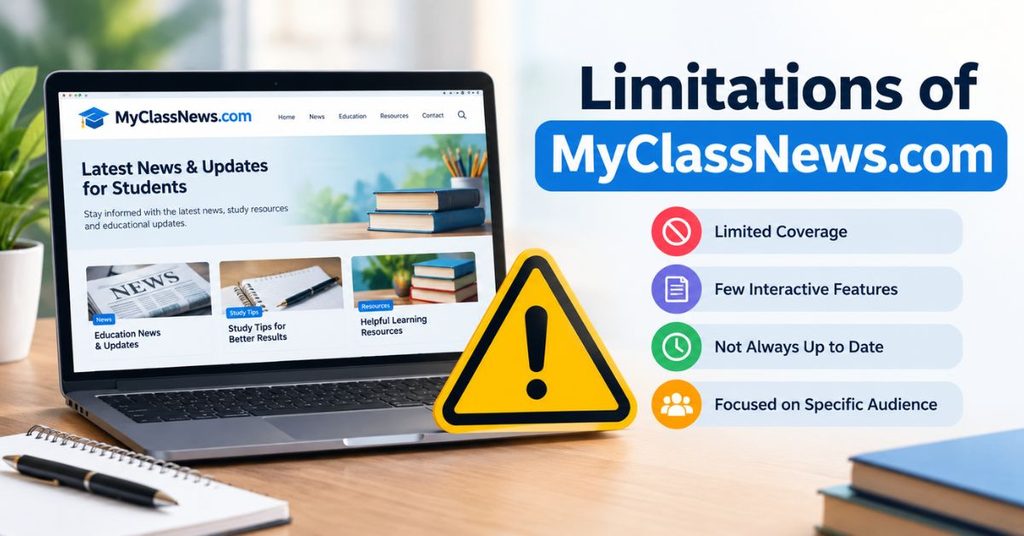
Here’s where honesty matters most. Based on everything above, here are the realistic limitations and open questions:
- No confirmed editorial standards — there’s no publicly available information about who fact-checks content or how corrections are handled.
- No confirmed ownership — without a named publisher, accountability is murky if something inaccurate gets published.
- No documented educator endorsements — no school district, teacher association, or library resource list I could find references the site directly.
- Generic naming creates confusion — the name overlaps conceptually with private school software tools, alumni “class news” pages, and other unrelated services, making it easy to conflate different things under one label.
- Unclear content freshness — without visible publish dates and a consistent cadence, it’s hard to know if you’re reading current information or recycled filler.
None of this means the site is definitely low-quality. It means the burden of verification sits with you, and that’s worth knowing upfront rather than discovering after you’ve already assigned it to a class.
Frequently Asked Questions
What is MyClassNews.com?
Based on its name, it appears to be an education-oriented news aggregation site aimed at students, teachers, or parents. There isn’t enough independently verifiable public information — ownership records, press coverage, or educator reviews — to confirm exactly what it offers or how it operates beyond what’s visible on the site itself at any given time.
Is MyClassNews.com safe for students?
That depends on three things: whether the site uses secure browsing (HTTPS), whether it collects any personal data from users (which triggers COPPA obligations for children under 13 in the U.S.), and whether the content itself is age-appropriate and accurate. Since no independent safety audit or educator review of the site is publicly available, the responsible approach is to review it firsthand — check for a privacy policy, avoid entering any personal information, and read a sample of the content — before recommending it to students.
Can students use MyClassNews.com for homework or research?
For light reading or discussion, possibly. For formal research or citations, it’s a weaker choice than established outlets, since there’s no visible editorial policy, named authors, or sourcing standard to point to if a teacher or professor asks where a fact came from. Established educational news sources (see the alternatives below) are generally the safer bet for anything that needs to be cited.
Who owns MyClassNews.com?
Public ownership records for this domain aren’t available through standard lookup channels or in any indexed source I found. If ownership information isn’t disclosed on the site itself, that’s worth factoring into how much trust you extend to its content.
Is MyClassNews.com endorsed by educators or schools?
No school district, teachers’ association, library resource guide, or educator review site referencing MyClassNews.com by name turned up in research for this article. That doesn’t rule out small-scale or informal use, but there’s no documented, formal endorsement to point to.
How does MyClassNews.com compare to established educational news sources?
Established outlets like CNN 10, TIME for Kids, DOGO News, Newsela, and Scholastic News all have verifiable publishers, named editorial staff, clear sourcing practices, and — in several cases — direct partnerships with schools and curriculum providers. MyClassNews.com currently lacks the public documentation to make an equivalent comparison. It may still be a fine supplementary resource, but it doesn’t come with the same track record.
Is the content on MyClassNews.com accurate?
That can only be judged by reading the content itself and checking it against original sources, since there’s no independent fact-checking record or editorial standard publicly available for the site. As a general rule, treat any single-source news site — regardless of name — as a starting point rather than a final authority.
What are better alternatives to MyClassNews.com for educational content?
Here’s a short list of well-documented, widely used options:
| Resource | Best For | Notable Feature |
|---|---|---|
| Newsela | K-12 classrooms | Adjustable reading levels for the same article |
| DOGO News | Elementary/middle school | Kid-friendly layout, quizzes built in |
| TIME for Kids | Elementary school | Backed by TIME’s editorial standards |
| CNN 10 | Middle/high school | Daily 10-minute video news digest |
| Scholastic News | K-8 classrooms | Long-running, curriculum-aligned print and digital editions |
| PBS NewsHour Extra | High school | In-depth coverage with lesson plans for teachers |
Each of these has a transparent publisher, named editorial teams, and — in most cases — direct classroom adoption you can actually verify through school district resource pages.
A little more detail on the three most widely adopted options, since they come up constantly in teacher forums and district resource lists:
- Newsela is built specifically around the idea of the same article at multiple Lexile reading levels, so a teacher can assign one topic across a mixed-ability classroom without rewriting anything. It’s used by a large share of U.S. school districts and integrates with common learning management systems.
- DOGO News leans younger, with a simpler layout, built-in comprehension questions, and a comment section moderated for a school-safe environment — useful if classroom discussion is the main goal rather than independent reading.
- CNN 10 takes a completely different format: a daily ten-minute video news roundup, deliberately kept free of graphic content and opinion commentary, designed to be watched as a class rather than read individually.
None of these are perfect or universally loved — some teachers find Newsela’s tone too simplified for older students, and CNN 10’s video format doesn’t suit every lesson plan — but all three have a track record you can actually research, which is the real advantage over an unverified site.
Read Also: AdsWynk.com Explained: Features, Uses, Benefits & More
A Reusable Evaluation Table
Bookmark this table. Use it on myclassnews.com, on whatever alternative you pick, and on the next unfamiliar education site that shows up in your search results a year from now.
| Criterion | Green Flag | Red Flag |
|---|---|---|
| Ownership | Named person or company, findable elsewhere online | Hidden or absent |
| Authors | Named bylines with any track record | Generic “Staff” or no byline |
| Sourcing | Links to original reporting | No links, vague attribution |
| Dates | Recent, consistent publishing | Missing or clustered dates |
| Privacy policy | Present, specific, COPPA/FERPA-aware | Absent or boilerplate |
| Ads | Clearly disclosed, not aimed at kids | Aggressive, undisclosed, or child-targeted |
| Community feedback | Findable mentions, positive or mixed | Total search silence |
Does MyClassNews.com collect personal data from students?
There’s no publicly available privacy policy documentation to confirm this either way. If the site asks for an email address, an account sign-up, or any other personal information, treat that as the trigger to stop and look for a clearly posted, compliant privacy policy before proceeding — especially for anyone under 13, where COPPA obligations apply.
Should schools add MyClassNews.com to an approved resource list?
Not without doing the verification steps outlined above first. Most districts require a data privacy agreement before any third-party site touches student information, and an approval process typically also checks content standards and accessibility. Until those boxes are checked through your school’s normal vetting process, it’s safer to treat the site as unverified rather than pre-approved.
Conclusion
MyClassNews.com might be useful, or it might just be another forgettable name in a crowded space. Right now, there’s no solid trail of ownership, editorial standards, or educator feedback to settle that question for you. So don’t take the name at face value. Spend five minutes checking it yourself before you trust it with a classroom or a curious kid. When in doubt, lean on one of the established alternatives above instead.
