

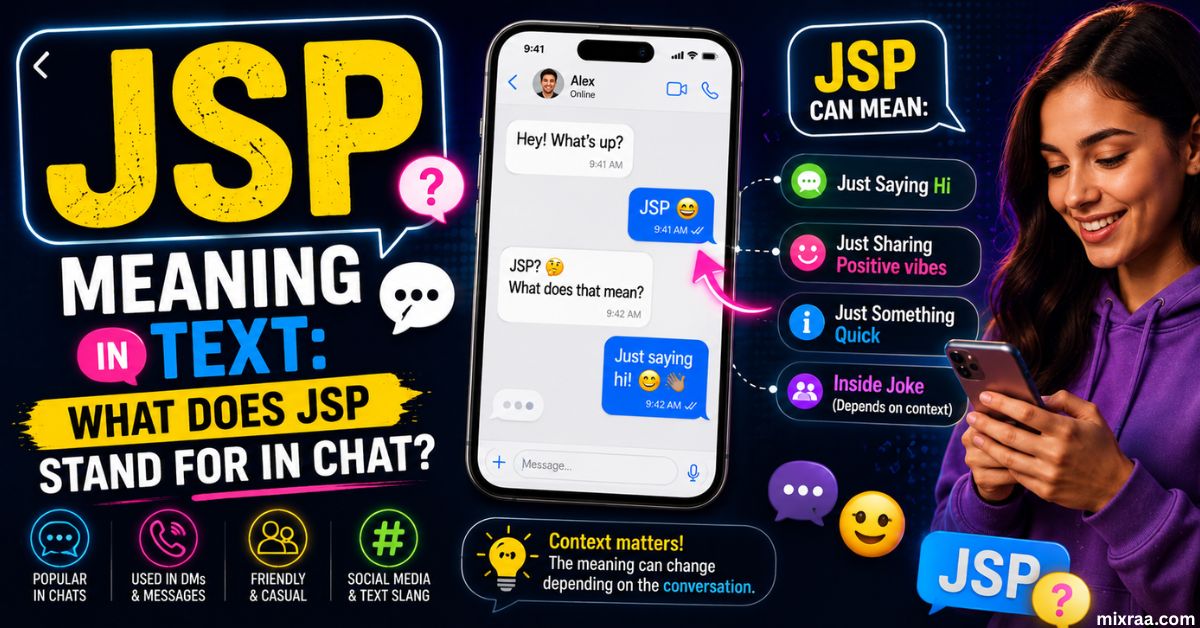
If someone suddenly sends “JSP” in a text, you might wonder what those three letters actually mean. Unlike common abbreviations such as LOL, IDK, or BTW, JSP isn’t used with one universal meaning everywhere.
In casual English conversations, JSP can mean “Just Playing.” People may use it after teasing someone, making an exaggerated statement, or saying something they don’t want the other person to take seriously.
However, context matters. The same abbreviation can mean something completely different in another language or subject. For example, jsp can appear in French texting as a shortened form of je sais pas, meaning “I don’t know.” In technology, JSP is also associated with JavaServer Pages.
So, what does JSP mean in text? If you’re looking at a casual English conversation, “Just Playing” may be the intended meaning. The surrounding message is the best clue.
What Does JSP Mean in Text?
In casual English texting, JSP commonly means “Just Playing.”
People use it when they’ve made a playful statement and want to make their intention clear. Think of it as a small signal that says, “Don’t take what I just said too seriously.”
For example:
“You’re never choosing the movie again. JSP 😂”
The first part sounds serious at first. The addition of JSP changes the tone and shows that the sender is probably teasing.
Another example:
“I’m blocking you for eating my fries. JSP.”
The sender isn’t necessarily announcing a real decision. They’re using exaggerated language for humor.
This makes JSP similar to expressions such as “I’m kidding,” “I’m joking,” or sometimes “JK.” Still, the exact feeling can differ. “Just Playing” often has a teasing or messing-around quality.
JSP Meaning Text at a Glance
| Abbreviation | Possible meaning | Typical use |
|---|---|---|
| JSP | Just Playing | Casual English conversation |
| jsp | Je sais pas (“I don’t know”) | French texting |
| JSP | JavaServer Pages | Web development |
The important word here is possible. JSP doesn’t have one fixed definition that applies to every conversation.
If you want to understand jsp meaning in text, always consider what the person said before and after the abbreviation.
What Does JSP Stand For?
When someone uses JSP to mean “Just Playing,” the abbreviation comes from the first letters of the phrase:
- J = Just
- S = Playing
- P = Playing
At first glance, that might look unusual because “Playing” contributes two letters. Texting slang doesn’t always follow a strict abbreviation formula. People create shortened expressions based on what feels quick and recognizable within their conversations.
That’s also why internet slang can be inconsistent.
One group might use an abbreviation regularly while another group has never seen it before. A term can become familiar in one online community without becoming universal across the entire internet.
This explains why searching what does jsp mean can lead to different interpretations.
The safest approach isn’t to memorize one definition and apply it everywhere. Instead, look at the language, subject, and tone of the message.
What Does JSP Mean in Texting?
The jsp meaning in texting often depends on the sentence surrounding it.
Suppose a friend writes:
“You’re officially banned from touching my snacks. JSP 😂”
The dramatic wording suggests a joke.
Now imagine someone simply sends:
“JSP.”
That message is much harder to interpret without context.
The abbreviation itself doesn’t tell you everything. You need the conversation around it.
Common Situations Where JSP May Appear
When JSP means “Just Playing,” someone might use it after:
- A joke
- A playful insult
- An exaggerated complaint
- Friendly teasing
- A sarcastic comment
- A dramatic statement
- A deliberately ridiculous claim
For instance:
“You’re the worst teammate ever. JSP.”
Or:
“I’m telling everyone you did that. JSP 😂”
Or:
“You actually believed me? JSP.”
In each case, the abbreviation helps soften the statement.
Does JSP Always Appear at the End?
No.
Texting doesn’t follow the same rules as formal writing. Someone could place JSP at the beginning, middle, or end of a message.
For example:
“JSP, I’m not actually mad.”
Or:
“I’m JSP, don’t worry.”
However, when someone uses it to clarify a previous joke, placing it after the statement usually makes its purpose easier to understand.
Capitalization isn’t fixed either. You may see:
- JSP
- jsp
- Jsp
The capitalization generally doesn’t determine the meaning in casual chat.
How JSP Is Used in Different Conversations
The meaning of an abbreviation becomes much easier to identify when you examine the type of conversation.
A message between close friends can contain slang that would sound strange in a classroom or workplace. Likewise, a programming discussion can use JSP as a technical term rather than internet slang.
Casual Conversations
Among friends, JSP can work as a quick way to clarify a playful comment.
“I’m never talking to you again. JSP 😭”
The exaggerated statement provides the joke. JSP signals that the sender isn’t being completely serious.
Group Chats
Group chats often contain rapid-fire jokes, teasing, memes, and short reactions. An abbreviation can help people understand the intended tone without requiring a longer explanation.
For example:
“You guys are impossible 😂 JSP.”
The exact meaning still depends on what happened earlier in the conversation.
Online Comments and DMs
People also use short expressions in social media messages because they’re quick to type. However, not every person will understand every abbreviation.
That’s important when talking to someone you’ve never met.
If the person doesn’t know what JSP means, the abbreviation can create more confusion instead of reducing it.
JSP in Texting vs. Real-Life Conversation
Texting and face-to-face conversation have one major difference: written messages don’t automatically carry your voice or facial expressions.
When you joke with someone in person, they can hear whether you’re being serious. They can also see your smile or laugh.
A text message removes many of those signals.
Consider this sentence:
“Wow, you’re really helpful.”
Depending on the situation, that could be sincere praise or sarcasm.
Now imagine the same person follows it with:
“JSP 😂”
The added abbreviation gives the reader another clue about the intended tone.
That’s one reason short expressions become useful in digital conversations. They can act like small pieces of emotional punctuation.
Do People Say JSP Out Loud?
Usually, people don’t need to say “JSP” aloud when they mean “Just Playing.”
In normal conversation, someone would more naturally say:
- “I’m just playing.”
- “I’m joking.”
- “I’m kidding.”
- “I’m messing with you.”
Texting slang exists partly because typing a few letters can be faster than writing an entire phrase.
That doesn’t mean every abbreviation belongs in spoken language. Some stay almost entirely inside digital communication.
JSP Meaning in Text: Real Examples
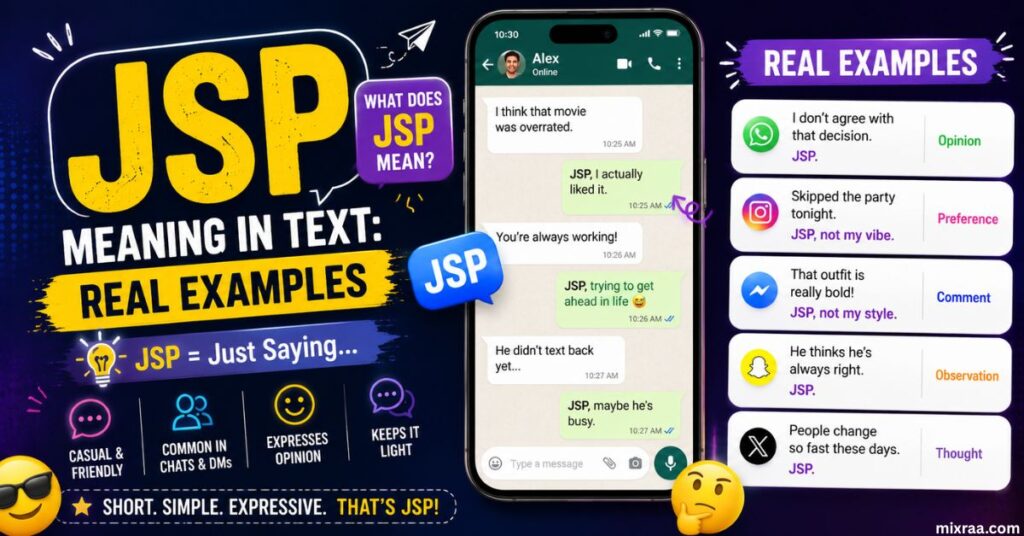
Examples make the JSP meaning text easier to understand because the surrounding context shows how the abbreviation works.
Example: Friendly Teasing
Mia: You ate my last cookie.
Sara: I ate your whole snack drawer. JSP 😂
The exaggerated second statement makes the joke obvious.
Example: Playful Threat
Ali: You forgot my birthday.
Hamza: I’m never speaking to you again. JSP.
The statement sounds serious for a moment, but JSP signals that it’s playful.
Example: Sarcasm
A: I finished the project five minutes before the deadline.
B: Incredible planning. JSP 😂
The response uses humor rather than genuine praise.
Example: Lighthearted Complaint
“You always steal the best seat. JSP.”
The sender may genuinely be annoyed, but the abbreviation makes the message less confrontational.
Example: Simple Clarification
“I can’t believe you did that. JSP, I’m not actually mad.”
Here, the sender directly explains the intended tone.
JSP Meaning Can Change With Context
One of the biggest mistakes people make with slang is assuming that every abbreviation has only one meaning.
JSP is a good example.
Imagine these three conversations:
Conversation A — Friends
“You seriously picked that movie? JSP 😂”
Here, “Just Playing” makes sense.
Conversation B — French conversation
“Jsp ce que je dois faire.”
Here, the surrounding French language changes the interpretation.
Conversation C — Programming
“The application still uses JSP pages.”
Here, the abbreviation is clearly being used as a technical term.
The three letters haven’t changed. The context has.
That’s why understanding slang requires more than memorizing abbreviations.
Other Meanings of JSP You Should Know
Although this article focuses on JSP meaning in text, the abbreviation has other established uses.
JSP in French Texting
In French online communication, jsp can be used as a shortened form of je sais pas.
The phrase means:
“I don’t know.”
For example, a French-language message might use jsp when the person isn’t sure about an answer or decision.
This is completely different from “Just Playing.”
If you’re reading a conversation containing French vocabulary, don’t automatically assume that JSP refers to English slang.
JSP in Web Development
In programming, JSP commonly refers to JavaServer Pages.
This has nothing to do with texting slang.
JavaServer Pages is a Java-based technology associated with generating dynamic web content. Developers may encounter JSP files, JSP pages, or JSP-related code while working with older or established Java web applications.
So if someone says:
“I’m debugging a JSP page.”
They’re almost certainly talking about software rather than chat slang.
Why Multiple Meanings Exist
Abbreviations are efficient because they compress longer phrases into a few characters.
The downside is obvious: different communities can create the same abbreviation independently.
That’s why three letters can carry completely different meanings in:
- Social conversations
- Different languages
- Programming
- Online communities
- Specialized fields
Context acts as the filter.
JSP vs. Similar Texting Abbreviations
If you’re learning texting slang, JSP can look similar to several other abbreviations.
Here’s a quick comparison:
| Abbreviation | Meaning | How it’s commonly used |
|---|---|---|
| JSP | Just Playing | Shows playful intent |
| JK | Just Kidding | Clarifies that something was a joke |
| LOL | Laughing Out Loud | Shows amusement or a light tone |
| IDK | I Don’t Know | Shows uncertainty |
| TBH | To Be Honest | Introduces a direct opinion |
| IMO | In My Opinion | Marks a personal viewpoint |
JSP vs. JK
These two are the easiest to confuse.
JK directly communicates that the person is kidding.
JSP, when used as “Just Playing,” emphasizes that the person is playing around or teasing.
For example:
“You’re buying dinner tonight. JK.”
versus:
“You’re buying dinner tonight. JSP.”
Both can soften a statement, but their wording isn’t identical.
Don’t treat texting abbreviations like mathematical formulas. Real conversations are flexible.
Is JSP Safe for Kids and Teens?
When JSP means “Just Playing,” the abbreviation itself isn’t a swear word or an inherently harmful expression.
It’s simply a casual way to indicate playful intent.
That said, the message surrounding the abbreviation matters more than the abbreviation itself.
For example:
“I’m never talking to you again. JSP.”
is generally a playful statement between friends.
But if someone uses unfamiliar slang alongside threatening, insulting, or otherwise concerning language, the full conversation deserves attention.
There’s also another issue: younger users may encounter abbreviations they don’t understand.
Instead of guessing, it’s better to ask:
“What does JSP mean here?”
A quick question can clear up confusion immediately.
A Simple Rule for Understanding Unfamiliar Slang
When a child or teen encounters an unfamiliar abbreviation, look at:
- The language of the conversation
- The sentence around the abbreviation
- The relationship between the people
- The overall tone
- Any emojis or surrounding messages
No single clue guarantees the meaning. Together, they usually provide enough information.
When Should You Use JSP?
If you’re using JSP to mean “Just Playing,” it works best in casual communication.
You might use it when chatting with:
- Friends
- Classmates
- People in casual group chats
- Online friends who understand the abbreviation
- People who regularly use similar slang
For example:
“You’re picking the restaurant next time. JSP 😂”
That’s perfectly suited to a casual conversation.
When JSP Fits Naturally
JSP can work when:
- You’re teasing someone.
- You’re making an exaggerated joke.
- You want to soften a playful statement.
- The other person understands texting slang.
- The conversation already has a casual tone.
The key isn’t simply knowing the abbreviation. It’s knowing when the other person will understand it.
When Should You Avoid JSP?
There are plenty of situations where writing the complete phrase makes more sense.
Avoid JSP in:
- Formal emails
- School assignments
- Job applications
- Business proposals
- Official documents
- Professional correspondence
- Important messages where ambiguity could cause trouble
For example, telling a teacher:
“That deadline is crazy JSP.”
wouldn’t communicate as clearly as:
“I think the deadline may be difficult to meet.”
The second version is direct and appropriate for a formal setting.
Why Clarity Matters
Slang depends on shared understanding.
If the other person doesn’t know JSP, they may stop and search for its meaning. Worse, they could interpret it incorrectly.
When something is important, clarity beats cleverness.
That’s especially true when you’re communicating with teachers, employers, customers, or people you don’t know well.
How to Figure Out What JSP Means in a Message
Still wondering what does jsp mean in texting when someone sends it to you?
Use a simple context-first approach.
Check the Language
Is the conversation written in English, French, or another language?
If it’s French, jsp may refer to je sais pas rather than “Just Playing.”
Read the Previous Message
Look at what the person said immediately before JSP.
If they just made an exaggerated joke, “Just Playing” becomes more likely.
Look for Tone Clues
Emojis can provide useful context.
For example:
“I’m deleting your number 😂 JSP”
The laughing emoji supports a playful interpretation.
However, don’t rely on emojis alone. People use them differently.
Consider the Topic
If you’re discussing Java development and someone mentions JSP, the technical meaning is much more likely.
If you’re discussing weekend plans with a friend, a texting meaning makes more sense.
Ask the Sender
If you’re still unsure, simply ask.
“What do you mean by JSP?”
There’s nothing awkward about asking. Slang changes quickly, and no one knows every abbreviation.
FAQS About JSP Meaning in Text
What does JSP mean in text?
In casual English texting, JSP can mean “Just Playing.” It’s generally used to show that a previous statement was playful, exaggerated, or not meant literally.
What does JSP mean in texting?
The JSP meaning in texting depends on context. In casual English, it can mean “Just Playing.” In French texting, jsp can represent je sais pas, meaning “I don’t know.”
What does JSP mean on Snapchat?
If the conversation is casual English and someone uses JSP after teasing or joking, “Just Playing” may be the intended meaning. The abbreviation doesn’t have a separate universal Snapchat definition.
What does JSP mean on Instagram?
JSP can be used in Instagram DMs or comments as casual slang. If the surrounding conversation is playful, “Just Playing” may fit. Context remains important.
Is JSP the same as JK?
No. JK means “Just Kidding,” while JSP can mean “Just Playing.” They can serve similar purposes when someone wants to clarify that a statement wasn’t serious.
Can JSP mean “I don’t know”?
Yes. In French internet communication, jsp can represent je sais pas, which means “I don’t know.” The language surrounding the abbreviation helps identify this meaning.
Does JSP have a technical meaning?
Yes. In web development, JSP commonly refers to JavaServer Pages. That technical meaning is unrelated to texting slang.
Is JSP a bad word?
No. When used as “Just Playing,” JSP isn’t inherently offensive. The surrounding conversation determines whether the overall message is appropriate.
Should you use JSP in formal writing?
Generally, no. Casual abbreviations can confuse readers in professional or academic settings. Writing the complete phrase usually provides better clarity.
Why can JSP have different meanings?
Abbreviations develop within different communities and languages. As a result, the same three letters can represent completely different phrases.
Final Takeaway: JSP Meaning in Text
So, what does jsp mean in text?
In casual English conversations, JSP can mean “Just Playing.” Someone may add it after a joke, tease, sarcastic comment, or exaggerated statement to show that they aren’t being completely serious.
But that’s only one possible interpretation.
In French texting, jsp can represent je sais pas, meaning “I don’t know.” In technology, JSP can refer to JavaServer Pages.
That gives you the most important rule for understanding jsp meaning in text:
Don’t judge the abbreviation alone. Read the conversation around it.
Look at the language, topic, tone, and previous messages. Once you consider those clues, the intended meaning usually becomes much clearer.
When someone uses JSP after a playful comment, “Just Playing” is a reasonable interpretation. When the conversation is French or technical, another meaning may fit much better.
Three letters can carry several meanings. Context tells you which one belongs in the conversation.
