

If you’ve typed “connections hint today mashable” into Google more than once this month, you’re not alone. Millions of people now open the New York Times Connections puzzle every morning the same way they used to check the weather — out of habit, and with a little bit of dread about whether today’s purple category is going to wreck their streak.
This guide walks through everything you need: what the game actually is, why so many players lean on mashable connections hint today posts instead of solving cold, the strategy that separates a clean win from a four-mistake loss, and where to actually find today’s answer without spoiling more than you want to see. Bookmark it. You’ll probably be back tomorrow.
What Is NYT Connections?
NYT Connections is a daily word puzzle published by The New York Times, and it’s become one of the most-played games in the paper’s digital lineup alongside Wordle and Strands. The concept is simple to explain and genuinely hard to execute: you’re given 16 words or short phrases, and your job is to sort them into four hidden groups of four, each built around a shared theme.
The catch is that the puzzle is deliberately built to mislead you. A word like “STRETCH” might look like it belongs with exercise terms, when really it’s part of a group of words that all pair with “MARK.” That’s the whole game, honestly — the Times’ puzzle team plants overlapping words on purpose so that your first instinct is often wrong.
The game launched in 2023 after the Times acquired it from its original creator, and it now sits inside the NYT Games app next to Wordle, Strands, the Mini Crossword, and Spelling Bee. Unlike Wordle, though, Connections punishes wrong guesses directly: get four mistakes and the puzzle ends before you see the full solution.
That built-in pressure is exactly why so many players now search for a connections hint today mashable post before they even open the game. A well-placed hint lets you keep your streak alive without just being handed the answer outright.
Why Mashable Connections Hint Today Is So Popular
Mashable publishes a daily Connections hints article, and it’s become one of the go-to stops for players who are stuck but don’t want the puzzle fully spoiled in one glance. The format matters here more than people realize. A mashable connections hint today post is built in layers:
- A soft, vague clue about each category (just enough to nudge you)
- The actual category titles, if the soft clue wasn’t enough
- The full solved groups, listed last, so you have to scroll on purpose to see them
That layered structure is the reason the format works so well. You control how much you want to know. Someone who just wants a nudge on the purple category can stop after step one. Someone who’s already made two mistakes and just wants their streak saved can scroll straight to the bottom.
There’s also a simple practical reason connections hints today mashable posts get so much daily traffic: the puzzle resets at midnight local time, which means people in different time zones are technically playing “today’s” puzzle at different real-world hours. A daily hints post gives everyone, regardless of when their midnight hits, a fresh, accurate answer key the moment they need it.
Quick fact check: according to Mashable’s own daily posts, each article is tied to a specific numbered puzzle (for example, puzzle #1,022 or #934), which is how outlets keep the hints accurate even when readers are checking from different corners of the world at different local times.
How NYT Connections Puzzle Works
Before diving deeper into strategy, it helps to understand the mechanics precisely, because a lot of avoidable mistakes come from misunderstanding the rules rather than the words themselves.
Here’s the basic structure:
| Element | Detail |
|---|---|
| Total words | 16 |
| Number of groups | 4 |
| Words per group | 4 |
| Mistakes allowed | 4 |
| Puzzle reset | Midnight, local time zone |
| Platform | NYT Games app and website |
You select four words you believe belong together and submit them. If you’re right, that row locks in place and disappears from the grid. If you’re wrong, you lose one of your four attempts, and the game gives you a small mercy: it tells you if you were “one away,” meaning three of your four picks were correct.
Difficulty Colors
Every solved group is color-coded by difficulty, and understanding the color system is one of the fastest ways to sharpen your strategy.
- Yellow — the most straightforward group, usually a literal category with little wordplay
- Green — still fairly direct, but often has one word that could plausibly fit elsewhere
- Blue — trickier, frequently involves a theme rather than a literal category
- Purple — the hardest tier, almost always wordplay: hidden words, homophones, or a shared prefix/suffix pattern like “___ MARK” or “SILENT P”
Purple is where most losses happen. It’s rarely about vocabulary — it’s about pattern recognition, and that distinction matters a lot for how you should actually approach the puzzle.
Why You Get Stuck in Connections
If you’ve ever nailed yellow and green in under a minute, then burned all four mistakes on blue and purple, you’re in extremely good company. There are a handful of very specific reasons this happens, and once you can name them, they get a lot easier to avoid.
Multiple meanings trip people up constantly. English is full of words that comfortably belong to two or three different categories at once. A word like “CHECK” could mean a restaurant bill, a chess move, a mark of approval, or part of a compound phrase. Connections exploits this on purpose, and the puzzle’s writers know exactly which words carry the most ambiguity.
Fake group patterns are planted deliberately. You’ll often spot four words that seem to share an obvious theme — say, four fruits, or four colors — only to find out that one of those “obvious” words actually belongs to the purple group instead, and a completely unrelated word slides into the fruit category in its place.
Overthinking simple answers wastes time and mistakes. Sometimes yellow really is just yellow. Players who assume every category has a hidden twist end up second-guessing an easy answer, delaying a guess they should’ve locked in immediately.
Early guessing errors set off a chain reaction. Submitting a guess too fast, before checking whether any of those four words fit better somewhere else, is probably the single biggest cause of lost games. One rushed guess can burn a mistake that costs you the whole puzzle later.
As one long-time Connections player put it in a Reddit thread on puzzle strategy: “The purple category isn’t testing your vocabulary. It’s testing whether you can stop trusting your first read of a word.”
That quote captures the whole game, honestly. Connections isn’t really a vocabulary test. It’s a pattern-recognition test wearing a vocabulary costume.
What Makes Mashable Connections Guide Useful
Not every hints site is built the same way, and the differences actually matter if you’re trying to protect a win streak. A strong mashable connections hint today guide tends to do a few things well:
- It separates soft hints from full answers clearly, so you never see more than you asked for
- It explains why a group works, not just what the four words are
- It’s updated daily, tied to the exact puzzle number, so there’s no confusion about which day’s answers you’re looking at
- It includes a recap of the previous day’s puzzle for readers checking in from a different time zone
That last point is genuinely underrated. Because Connections resets at local midnight, a reader in one time zone might be several hours behind a reader in another, both technically playing “today’s” game. A guide that also covers yesterday’s puzzle prevents a lot of confused, frustrated searching.
Smart Strategy to Solve NYT Connections Faster
Once you understand why the puzzle tricks people, you can build a repeatable approach that works most days, not just the easy ones.
Read Also: Brumeblog Com Review 2026: Features, Pros, Cons & More
Start With Obvious Groups
Lock in the category you’re most confident about first, even if it isn’t yellow. Confidence should drive your first guess, not color. Starting with a group you’re genuinely sure of reduces the total word pool fast, which makes every remaining group easier to isolate.
Focus on Category Thinking
Instead of matching individual words to a theme, ask what connects the words as a set. A single word rarely tells you the category on its own — it’s the relationship between all four that matters. This is the mental shift that separates fast solvers from people who keep guessing individual words in isolation.
Use Elimination Method
Once one group locks in, immediately reconsider the remaining 12 words. A word you thought belonged to the “fruit” group might now be the missing piece of a wordplay category you hadn’t spotted yet. Elimination isn’t a passive step — it should actively reshape your read of every remaining word.
Watch for Trap Words
Every puzzle typically hides at least one trap word: a term that fits an obvious category almost perfectly, but actually belongs in the tricky one. If four words seem “too easy” together, pause and check whether one of them has a second meaning that fits the purple pattern instead.
Think in Patterns, Not Words
Purple categories especially reward pattern-spotting over vocabulary. Ask yourself: could these words all follow the same word? Precede the same word? Share a hidden smaller word inside them? Sound like something else out loud? That last one catches more people than any other trick in the game — homophones are a Connections favorite.
Here’s a quick reference table for approaching each color tier:
| Color | Typical Trap | Best Approach |
|---|---|---|
| Yellow | Rarely tricky | Guess quickly if confident |
| Green | One overlapping word | Double-check against blue/purple |
| Blue | Thematic, not literal | Look for a shared concept, not shared category |
| Purple | Wordplay, homophones, hidden patterns | Say the words out loud; look for shared prefixes/suffixes |
Example Breakdown: How Solving Works
Theory only goes so far, so let’s walk through how a real solve plays out, using the structure of an actual published puzzle to show the thought process step by step.
Imagine you’re given these 16 words: GRAFFITI, RECEIPT, STRETCH, HUSTLE, PSYCHO, ROBOT, BEAUTY, STENCIL, POSTER, CORPS, TWIST, QUESTION, CHECK, MASHED POTATO, MURAL, COUP.
Step 1: The “Obvious” Trap
Your eye probably jumps straight to GRAFFITI, STENCIL, POSTER, MURAL — they all sound like street-art terms. That instinct is correct here, and it’s genuinely the yellow group: images seen on the street. Locking this one in first shrinks your working pool from 16 words down to 12.
Step 2: Spotting the Theme Group
Next, look at HUSTLE, ROBOT, TWIST, MASHED POTATO. Individually these look unrelated — a dance move, a machine, an action, a food. But as a set, they share something: they’re all retro dance crazes. That’s the green group. This is a great example of “category thinking” over “word matching,” since none of these words look connected until you consider them together.
Step 3: The Wordplay Group
Now you’re left with RECEIPT, PSYCHO, CORPS, COUP, BEAUTY, CHECK, QUESTION, STRETCH. This is where most mistakes happen. Say them out loud, and a pattern appears: RECEIPT, PSYCHO, CORPS, and COUP all contain a silent “p” sound. That’s the blue group, and it only reveals itself through sound, not spelling — a classic Connections move.
Read Also: Do the driving modes in cadillac lyriq offer different ranges or battery usages?
Step 4: The Purple Finish
That leaves BEAUTY, CHECK, QUESTION, STRETCH. Each one pairs naturally with the word “MARK” — beauty mark, checkmark, question mark, stretch mark. That’s your purple category, and it’s the kind of pattern that only becomes obvious once every easier group has been cleared out of the way.
This exact structure — literal category, thematic category, sound-based category, and a “word + common suffix” category — repeats constantly in Connections. Once you recognize the four archetypes, new puzzles stop feeling random and start feeling familiar.
Case Study: How One Streak Survived a Brutal Purple Category
It helps to see the strategy applied under real pressure, not just in a clean walkthrough. On a puzzle covering the theme “STEAL,” “DAPPER,” “DO SOME GROOMING,” and a suffix pattern of “___STONE,” one puzzle blogger documented exactly where their solve nearly fell apart.
The player correctly grouped NICK, PALM, PINCH, POCKET early, sensing they all meant “to steal” in casual speech. But a second read revealed a dangerous overlap: NICK, SHAVE, BRUSH, and PINCH could just as easily be read as “things you do that involve scraping or catching,” which isn’t a category in the puzzle at all — it was a false pattern their brain built on its own.
They caught the error before submitting, because two of the four words they’d need for that fake group — DAPPER-adjacent grooming terms — clearly belonged to a separate, real category: BRUSH, DRESS, SHAVE, SHOWER, all meaning “do some grooming.” That single check, done before locking anything in, saved a mistake that would have cost them their streak.
The final board broke down like this:
| Group | Theme | Words |
|---|---|---|
| Yellow | STEAL | NICK, PALM, PINCH, POCKET |
| Green | DAPPER | NEAT, SHARP, SMART, TIDY |
| Blue | DO SOME GROOMING | BRUSH, DRESS, SHAVE, SHOWER |
| Purple | ___STONE | BIRTH, KEY, MILE, TOUCH |
Their own recap afterward summed up the lesson well: two of the groups were connected almost poetically, since doing some grooming is part of looking dapper, but that surface-level connection between categories was a coincidence, not a clue. The real solve came down to slowing down before submitting a guess that felt obvious.
That’s the pattern worth remembering: the puzzle isn’t just testing whether you know what the words mean. It’s testing whether you’ll double-check a guess that feels too easy before you lock it in.
Connections Compared to Other NYT Word Games
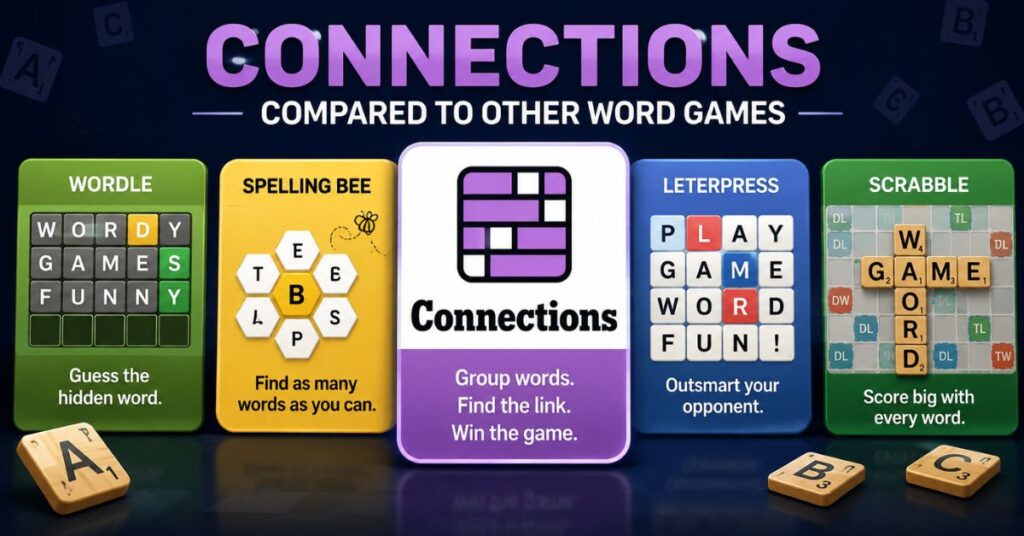
Part of why connections hints today mashable posts get checked alongside other daily puzzle guides is that Connections fits into a bigger daily ritual for a lot of players. Here’s how it stacks up against its NYT Games siblings:
| Game | Format | Mistakes Allowed | Core Skill Tested |
|---|---|---|---|
| Wordle | Guess a 5-letter word in 6 tries | Unlimited guesses, 6-try limit | Deduction, letter frequency |
| Connections | Sort 16 words into 4 groups of 4 | 4 mistakes | Pattern recognition, wordplay |
| Strands | Find hidden theme words in a letter grid | Limited “hints,” no hard fail | Spatial scanning, theme-spotting |
| Mini Crossword | Small crossword grid | Unlimited, timed | Vocabulary, clue-solving speed |
Connections is unique among these because it’s the only one where a single rushed guess can end your game outright. Wordle gives you six tries no matter what. Strands doesn’t really “fail” you. Connections is the one puzzle in the lineup where patience is directly rewarded and impulsiveness is directly punished, which is exactly why hint posts are so heavily trafficked for this specific game compared to the others.
Why Daily Practice Matters
Connections rewards pattern memory more than raw vocabulary, and that’s genuinely good news for anyone who feels intimidated by it. The puzzle’s writers reuse certain types of tricks even though the words themselves change daily — homophones, hidden smaller words, shared prefixes, and category overlaps show up again and again.
Players who solve daily, even briefly, start recognizing these structures almost automatically after a few weeks. What used to take ten minutes and two mistakes starts taking ninety seconds with a clean sweep. This is also exactly why regularly checking a connections hint today mashable post — even just to compare your solve against the explanation — builds pattern recognition faster than solving in isolation. Seeing why a trap worked teaches you to spot the next one.
Common Mistakes to Avoid
A short, practical list worth keeping in mind every time you open the puzzle:
- Guessing too fast on an “obvious” group without checking if a word fits somewhere else better
- Ignoring how words sound, especially on blue and purple tiers where homophones are common
- Forgetting overlap categories exist — assuming every word only has one possible home
- Locking in three confident words plus one guess instead of waiting for a full four-word match you’re sure of
- Skipping the “one away” signal — if the game tells you that, don’t just swap a random word; think through which of your four is the weak link
Advanced Thinking Technique
For players who’ve moved past the basics, the strongest technique is what puzzle communities sometimes call reverse elimination: instead of building groups forward from words you’re confident about, start by identifying the single word you’re least sure belongs anywhere. That word is very often the key to the purple category, since purple frequently contains the puzzle’s most disguised or unusual term.
Once you isolate that “odd word out,” work backward — what’s the least obvious thing it could connect to? Nine times out of ten, that question leads straight to the hardest group in the puzzle, faster than trying to solve purple last by process of elimination alone.
Why Every Puzzle Feels Different
Even with a solid strategy, some days feel brutally hard while others feel almost too easy — and that’s by design, not inconsistency. The Connections team varies difficulty deliberately across the week, similar to how the NYT Crossword gets harder from Monday to Saturday. Categories also rotate between purely literal groupings, pop culture references, wordplay, and abstract themes, so no single strategy works identically every single day.
That variability is actually the appeal for a lot of regular players. It’s also exactly why so many people check nyt connections mashable hint posts daily rather than relying purely on memorized tricks — the puzzle is built to stay one step ahead of pattern memorization, which keeps it genuinely fresh.
FAQs
What is Mashable Connections hint today?
It’s Mashable’s daily published guide to that day’s NYT Connections puzzle, offering a layered set of soft hints, category titles, and full answers, updated every day the puzzle resets.
Are hints and answers the same?
No, and this distinction matters. A hint gives you a nudge — a vague clue about a category’s theme — without revealing the actual grouped words. The answer is the full solved puzzle, words and categories both. Most connections hint today mashable posts separate the two clearly so you can choose how much help you want.
Why is NYT Connections difficult?
Because it’s built around intentional ambiguity. Words are chosen specifically because they can plausibly fit more than one category, and the puzzle rewards recognizing patterns — sound, prefixes, hidden themes — over simple vocabulary knowledge.
How can I improve quickly?
Play daily, even when you’re stuck, and read the explanation afterward instead of just accepting the answer. Understanding why a trap worked builds the pattern recognition that makes future puzzles easier. Comparing your guesses against a connections hint mashable post is one of the fastest ways to learn the puzzle’s recurring tricks.
What is the best strategy for beginners?
Start with the category you’re most confident about, regardless of color. Avoid guessing on instinct alone — check whether any of your four chosen words could reasonably belong somewhere else first. And when in doubt, say the words out loud; sound-based tricks are extremely common.
Final Thoughts
NYT Connections looks simple on the surface — 16 words, four groups but it’s really a daily lesson in not trusting your first read of a word. The good news is that it’s a learnable skill, not a luck-based one. The more puzzles you work through, whether solo or with a mashable connections hint today post open in another tab, the faster you’ll start spotting the traps before they cost you a mistake.
Come back tomorrow for the next puzzle, and don’t be afraid to peek at a hint when you’re stuck. That’s exactly what they’re there for.
