

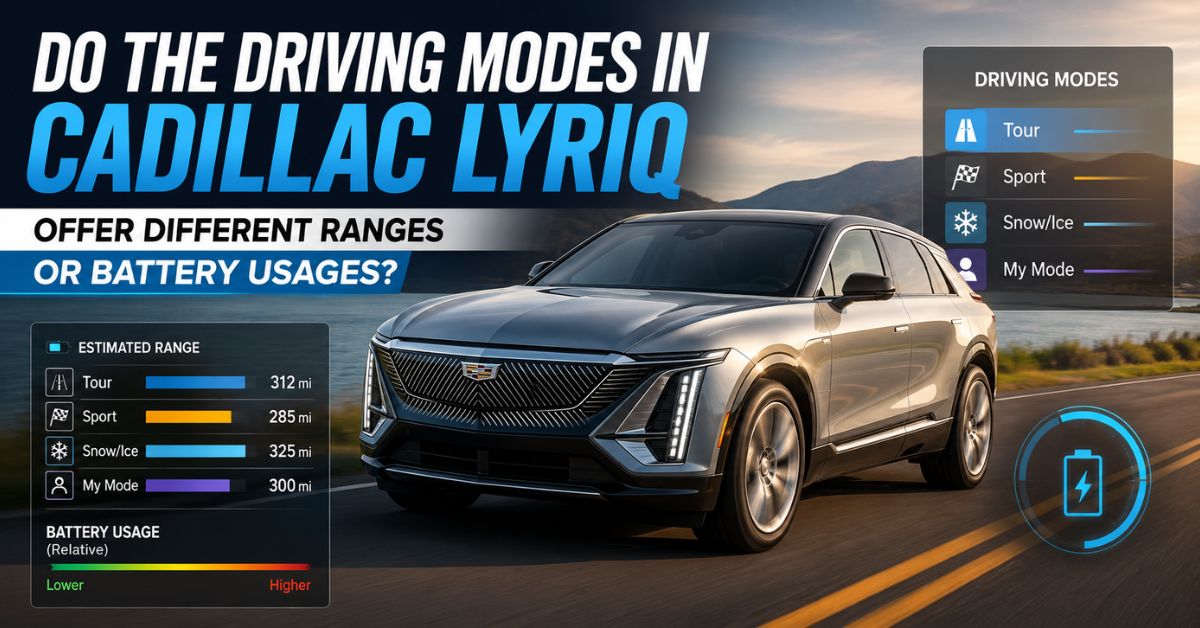
If you’ve spent any time behind the wheel of a Cadillac LYRIQ, you’ve probably noticed that little mode selector and wondered what it’s really doing. Tap over to Sport, and the whole car feels different. Switch to Snow/Ice, and it suddenly feels calmer, almost cautious. So it’s natural to ask: do the driving modes in Cadillac Lyriq offer different ranges or battery usages?
It’s one of the most common questions LYRIQ owners type into forums, and honestly, it deserves a straight answer instead of the usual runaround.
Let’s clear it up, once and for all, with real numbers instead of guesswork.
The Short Answer
Here’s the deal, stated plainly: the battery in your LYRIQ never changes size. Whether you’re in Tour, Sport, Snow/Ice, or a custom My Mode setup, you’re pulling from the exact same 102 kWh Ultium battery pack. No mode locks away a portion of that capacity, and no mode unlocks bonus miles you couldn’t get otherwise.
What does change is how quickly you burn through that capacity. Each mode adjusts throttle sensitivity, torque delivery, and regenerative braking behavior. Sport mode doesn’t drain your battery just by existing, but it does make aggressive driving feel effortless, and aggressive driving is what actually eats range. Tour mode, by contrast, nudges you toward smoother inputs that sip energy instead of gulping it.
So if you’re wondering whether do the driving modes in Cadillac Lyriq offer different ranges or battery usages has a yes-or-no answer, it’s really “yes, but indirectly.” The mode shapes your driving behavior, and your driving behavior determines your range.
What a Driving Mode Actually Changes
Think of a driving mode less like a physical switch and more like a personality setting for your car’s software. Nothing under the hood gets swapped out. The motors stay the same. The battery cells stay the same. What flips is a set of calibration parameters that tell the car how to respond to your inputs.
Here’s what typically shifts between modes:
- Throttle mapping — how much power the motor delivers for a given amount of pedal travel
- Torque delivery curve — how aggressively that power ramps up
- Regenerative braking strength — how much energy gets recovered when you lift off the accelerator
- Steering weight — how much resistance you feel through the wheel, on trims where this is adjustable
And here’s what stays completely fixed, no matter which mode you’re in:
- Battery chemistry and cell configuration
- Total usable kilowatt-hours (kWh)
- Motor hardware and maximum output ceiling
- Charging speed and behavior
That distinction matters. A driving mode is a set of instructions telling the car how to use its power, not a lever that changes how much power it has available. Once you internalize that, the whole “does Sport mode hurt my range” question becomes much easier to reason through.
The LYRIQ’s Mode Lineup
According to Cadillac’s owner’s manual, Driver Mode Control on the LYRIQ typically includes four selectable modes: Tour, Sport, Snow/Ice, and My Mode. Availability and exact tuning can vary a bit depending on trim and equipment, so a base Luxury trim and a performance-focused LYRIQ-V won’t feel identical even sitting in the same mode. Still, the core behavior of each one stays consistent across the lineup.
Tour Mode
This is the LYRIQ’s default setting, and for good reason. Tour mode is tuned around smoothness. Acceleration builds gradually rather than snapping forward, regenerative braking works at a balanced, efficient level, and the car avoids sudden power spikes that would otherwise chew through energy. If you’re commuting, running errands, or driving cross-country and want your trip odometer to match what the window sticker promised, this is the mode you want engaged.
Drivers who stick with Tour and keep their acceleration gentle tend to land closest to the official EPA range figures. That’s not a coincidence — EPA testing itself is conducted under steady, moderate driving conditions, which is essentially what Tour mode encourages every time you drive.
Sport Mode
Flip over to Sport, and the LYRIQ wakes up. Accelerator inputs become sharper, torque arrives faster, and the whole vehicle feels noticeably more eager. Cadillac describes Sport as delivering more immediate torque response along with firmer steering feel at higher speeds, which makes the SUV feel genuinely quick when you want it to be.
Here’s the catch: none of that responsiveness drains your battery just by sitting in the mode. The problem is behavioral. Sport mode is designed to reward harder acceleration, and harder acceleration is exactly what costs you range. Most people don’t switch to Sport to drive gently — they switch to it because they want to feel that punch, and every time you use it, you’re spending extra electrons to get it.
Snow/Ice Mode
Snow/Ice mode isn’t built with efficiency in mind at all — it’s built for control. Throttle response softens considerably, and torque gets delivered gradually rather than all at once, which helps prevent wheel slip on slick pavement. On genuinely icy or snow-covered roads, this can make the LYRIQ feel noticeably calmer and more predictable underfoot.
You might assume that gentler throttle input automatically means better range, and in a narrow sense, it sometimes does. But winter driving comes with its own separate penalties that have nothing to do with the mode itself — namely cold temperatures and heavy heater use. So even though Snow/Ice mode feels conservative, don’t expect it to offset the range losses that come with cold weather. It protects grip. It doesn’t cancel physics.
My Mode
My Mode is the wildcard. It lets you build a custom configuration by mixing and matching settings from the other profiles — maybe Sport-level throttle response with Tour-level regen, for example. Because it’s fully configurable, its impact on range depends entirely on how you set it up. Dial it toward efficiency, and it behaves like Tour. Dial it toward aggression, and it behaves like Sport.
Here’s a quick side-by-side to keep the four modes straight:
| Mode | Throttle Response | Regen Braking | Best For | Range Impact |
|---|---|---|---|---|
| Tour | Smooth, gradual | Balanced/strong | Daily driving, road trips | Closest to EPA rating |
| Sport | Sharp, immediate | Reduced feel, still functional | Performance driving | Noticeably lower with aggressive use |
| Snow/Ice | Soft, gradual | Reduced to limit slip | Icy or snowy roads | Minor on its own; winter conditions dominate |
| My Mode | Fully customizable | Fully customizable | Personalized setups | Depends entirely on configuration |
The Official EPA Numbers
Before going further, it helps to know the actual EPA-estimated figures Cadillac publishes for the LYRIQ, since real-world range conversations only make sense when you’re anchored to something concrete.
| Configuration | EPA-Estimated Range |
|---|---|
| Single-Motor RWD | Up to 326 miles |
| Dual-Motor AWD | Up to 319 miles |
| LYRIQ-V | 285 miles (Cadillac-estimated) |
These numbers come from standardized testing conditions, not from any single driving mode. The vehicle doesn’t get a new official range rating every time you tap the mode selector — the window sticker reflects one controlled test cycle, period. Real-world range in any mode is going to shift based on speed, temperature, terrain, and how heavy your right foot is that day.
How Much Range Do You Actually Lose in Sport?
This is where a lot of owner discussion happens, and while there’s no single official GM figure for “Sport mode range penalty,” a consistent pattern shows up across real-world reports and owner forums.
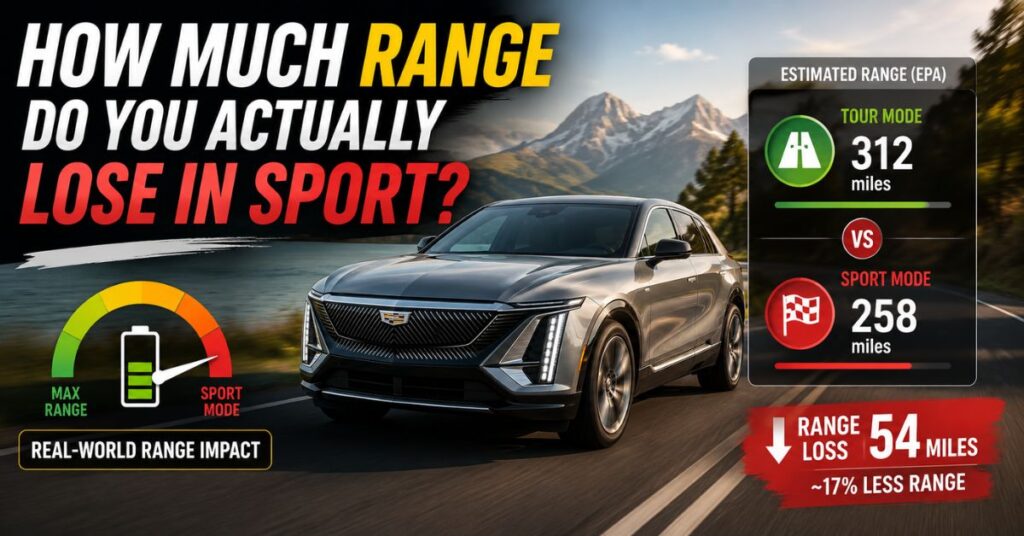
Consistent Sport mode use tends to reduce range by roughly 10% to 20% compared to Tour. Applied to the 326-mile RWD rating, that works out to somewhere around 260 to 295 miles on a full charge, depending on how aggressively you’re actually driving. Some drivers report gaps of 50 miles or more when Sport gets used for genuinely spirited driving rather than occasional acceleration.
It’s worth being upfront here: these figures are real-world estimates pulled from owner experience, not lab-tested specifications published by Cadillac. Two LYRIQ owners can drive the same trim in the same mode and land on very different numbers, because the mode is only part of the story. As one owner summed it up in a forum thread:
“I use Sport for merging and passing, then flip right back to Tour. My range barely moves. My buddy leaves it in Sport all day and swears his LYRIQ ‘eats battery.’ Same car, completely different habits.”
That’s really the whole story in one sentence. Sport mode is a tool, not a penalty box. Use it deliberately, and the range hit stays small. Use it constantly, and the battery keeps score.
Why Snow/Ice Isn’t About Saving Range
It’s tempting to think Snow/Ice mode should be a secret efficiency hack, since it softens throttle input and theoretically discourages the kind of hard acceleration that burns energy fast. In practice, that logic only holds up in a narrow, isolated sense.
Winter driving brings its own set of range penalties that exist completely independent of which mode you’ve selected:
- Cold battery chemistry — lithium-ion batteries lose efficiency as temperatures drop, meaning less usable energy from the same charge
- Cabin heating demand — running the heater draws real power, often more than climate control does in warm weather
- Battery preconditioning — the LYRIQ may use energy warming the pack before DC fast charging, which is smart for charging speed but adds to overall consumption
- Reduced regen braking — Snow/Ice mode intentionally limits regen to prevent wheel slip, which means less energy recovered while slowing down
Put those together, and you get a mode that feels gentle but often coincides with the lowest range numbers you’ll see all year. That’s not a flaw in Snow/Ice mode — it’s doing exactly what it’s designed to do, which is prioritize your safety on slick roads over squeezing out extra miles.
Read Also: Brumeblog Com Review 2026: Features, Pros, Cons & More
Regenerative Braking’s Role in All This
Regenerative braking deserves its own spotlight because it quietly does more for your range than most drivers realize. Every time you lift off the accelerator, the LYRIQ’s motors can act as generators, capturing kinetic energy that would otherwise be lost as heat through the brakes and feeding it back into the battery.
Regen strength varies by mode. Tour mode runs it at a balanced, efficient level. Sport mode can feel slightly different underfoot since the driving character shifts toward performance. Snow/Ice mode deliberately dials regen back to avoid triggering wheel slip on low-traction surfaces.
Regen matters most in stop-and-go environments — city streets, school pickup lines, traffic-choked commutes — where you’re constantly slowing down and speeding back up. On the open highway, where speed stays fairly constant, regen has far less opportunity to do its job, and other factors like aerodynamic drag start to dominate instead.
Separate from mode selection entirely, the LYRIQ also offers One-Pedal Driving, a feature that lets you accelerate and decelerate using just the accelerator pedal, maximizing regen capture without touching the brake at all. Owners who use it consistently in city driving often report efficiency gains in the range of 5% to 10%, which stacks on top of whatever mode you’ve chosen.
What Actually Moves the Needle More Than Mode Selection
Here’s the part that gets buried in most “which mode is best” discussions: your driving mode is a small lever compared to everything else affecting your range. The U.S. Department of Energy has noted that aggressive driving and high speeds reduce efficiency across all vehicle types, electric ones included — and that principle applies whether you’re in Tour, Sport, or anything in between.
The bigger factors, roughly in order of impact:
- Speed — Aerodynamic drag increases dramatically at higher speeds. Cruising at 80 mph instead of 65 mph can cost you noticeably more range than any mode selection ever will.
- Climate control — Heating and cooling the cabin draws real power, and in extreme temperatures, this can rival the energy used to actually move the car.
- Outside temperature — Cold weather reduces battery efficiency at a chemical level, independent of anything you do behind the wheel.
- Tire pressure and wheel size — Underinflated tires and larger wheels both increase rolling resistance, quietly eating into range over time.
- Cargo and roof load — Extra weight and disrupted aerodynamics (like roof racks or cargo boxes) add up more than most drivers expect.
- Terrain — Hills and elevation changes demand more energy climbing than you get back descending, even with strong regen.
Compare that list to what a driving mode actually controls — throttle mapping and regen tuning — and it becomes clear why mode selection alone rarely swings your range by more than 20%, while speed and temperature can swing it by far more.
Practical Takeaways by Use Case
Rather than treating this as an abstract debate, here’s how to actually apply it depending on what you’re doing behind the wheel:
- Daily commuting or errands: Stick with Tour. It’s tuned for exactly this, and you’ll consistently see numbers closest to the EPA rating.
- Long road trips where range matters: Use Tour, accelerate gently, and lean on regenerative braking rather than the brake pedal whenever traffic allows.
- Winter driving: Use Snow/Ice for the control it offers, but budget for range loss regardless — that loss is coming from the cold and the heater, not from the mode itself.
- Want the performance feel and don’t mind the trade-off: Sport is there for exactly that. Use it deliberately for merging, passing, or spirited stretches rather than leaving it engaged all day if range is a priority.
- Want full control: My Mode lets you build a hybrid setup — some drivers configure Sport-level throttle with Tour-level regen to get responsiveness without sacrificing as much efficiency.
Frequently Asked Questions
Do driving modes really change the Cadillac LYRIQ’s range?
Yes, but indirectly. The battery capacity itself never changes between modes — it’s always the same 102 kWh Ultium pack. What changes is throttle response and regenerative braking behavior, which shapes how you drive and how much energy you actually consume.
Which mode should I use for daily driving?
Tour mode is the best default for daily driving. It’s calibrated for smooth, predictable acceleration and efficient regen, which is why it tracks closest to the official EPA range figures.
Does Sport mode always cut range by the same amount?
No. The commonly reported range is roughly 10% to 20% less than Tour with consistent use, but it depends heavily on how aggressively you actually drive. Use Sport occasionally for merging or passing, and the impact on your overall range stays minimal.
Does Snow/Ice mode help or hurt efficiency?
Snow/Ice mode isn’t designed for efficiency at all — its job is traction and control. While its softer throttle input can technically reduce hard-acceleration losses, winter conditions typically cause range to drop anyway due to cold temperatures and heater use, regardless of which mode you’ve selected.
Is there a way to improve range without changing modes?
Yes. Gentler acceleration, using One-Pedal Driving in city traffic, keeping tires properly inflated, minimizing cargo and roof-rack use, and preconditioning the cabin while still plugged in can all improve real-world range independent of your mode selection.
Final Word
So, one more time, plainly: do the driving modes in Cadillac Lyriq offer different ranges or battery usages? The battery capacity stays exactly the same no matter what you pick. But the way each mode shapes your driving behavior absolutely does affect how far you’ll go on a charge.
Tour rewards patience with efficiency. Sport rewards enthusiasm with a range trade-off. Snow/Ice trades a little economy for real winter safety. And My Mode hands you the dials to strike whatever balance fits your driving style.
The mode selector isn’t a magic switch it’s a tool. Combine Tour mode with smooth inputs and smart charging habits, and your LYRIQ will consistently reward you with numbers that make the window sticker look honest.
